By Justin Fox
From undulating countryside blanketed with almond and olive groves to baroque cities, gnome-like houses and whitewashed Hellenic towns, this is southern Italy at its most seductive.
Italy’s deep South
Puglia lies at the heel of Italy’s famous boot and is the country’s longest region with the quaintest villages, stunning architecture and exquisite beaches strung along its 940km coastline. Puglia is also a foodies’ paradise with unique local dishes, delicious pastries and prized regional vino.
I had long wanted to visit Italy’s Deep South. My father, Revel Fox, and three uncles served in Italy during World War II and all of them spent time in Puglia. Dad landed with his Sherman tank in Taranto in 1944 and headed north, billeting in farmhouses, learning Italian and growing to love this beguiling land.
Two of my uncles recorded their time in Puglia with the South African Army, one of them (Uys Krige) as a war correspondent writing articles, poems and stories; the other (François Krige) as an official war artist painting and sketching the region, as well as recording the devastation wrought by Allied bombing on the towns of Puglia.
My uncle, François Krige, painted the terrible aftermath of the Allied bombing of Foggia, Puglia, in 1943
A base for adventuring
If you’re wanting to properly experience the region, it’s a good idea to base yourself centrally and use a hired car to go exploring. There’s greater need for a car in Puglia than elsewhere in Italy as the public transport system is not well developed, but fortunately the roads are much less busy than further north.
We rented a lovely farm-stay just outside Ostuni, the ‘white city’, which was central enough – at the bottom end of the trulli region and top of the hot, dry Salento region – to allow day trips to all corners of Puglia. Ostuni’s whitewashed citadel stretches across three hills with a magnificent cathedral as its centrepiece. It has some superb restaurants, stylish bars and a swish (mostly British expat) crowd.
Our quaint trullo house (a hobbit-like dwelling with a conical stone roof) was set on an olive farm and we frequently ate at home after stocking up at the local market or Carrefour in Ostuni. Evenings were spent wandering the old town, finding a cafe with sumptuous views over the Adriatic for an Aperol spritz sundowner, then wending our way through the lanes to a trattoria to sample local dishes such as orecchiette pasta with broccoli rabe or bombette (rolls of pork stuffed with cheese and herbs). Then an after-supper stroll with gelatos in hand before returning to our delightful trullo.
Perfect Hideaways has eight superb options in the Ostuni region, ranging from a 2-bedroom villa to a masseria with 6 bedrooms.
Masseria Moroseta (sleeps 12 in 6 bedrooms)
Casa Olivetta, between Cisternino and Ostuni (sleeps 8 in 4 bedrooms)
La Casetta (sleeps 4 in 2 bedrooms)
Tenuta Masseriola, near Carovigno (sleeps 8 in 4 bedrooms)
Villa Castellucio, near Ceglie Messapica (sleeps 6 in 3 bedrooms)
San Vito, near Lecce (sleeps 8 in 4 bedrooms)
Casa Maiora, near Carovigno (sleeps 8 in 4 bedrooms)
Villa Cardo, near Carovigno (sleeps 8 in 4 bedrooms)
Beaches for every palette
From Ostuni, we explored the Adriatic coast and were fortunate in that the local beaches, just 10 minutes from our trulli, were lovely. We chose Spiaggia di Torre Pozzelle, with its rustic watchtower and secluded coves lapped by warm, transparent water.
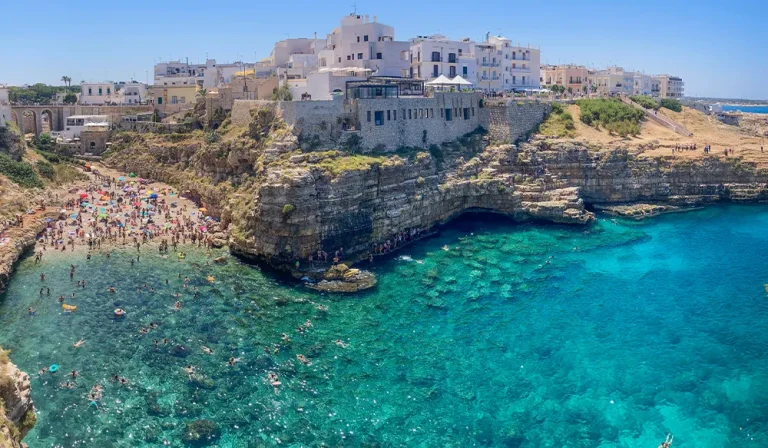
Heading north, we visited the coastal towns near Bari. Polignano a Mare’s Instagram famous Cala Porto beach sits in a gorge hemmed by towering cliffs (used for the Red Bull Cliff Diving competition), but it can get very crowded, so arrive early.
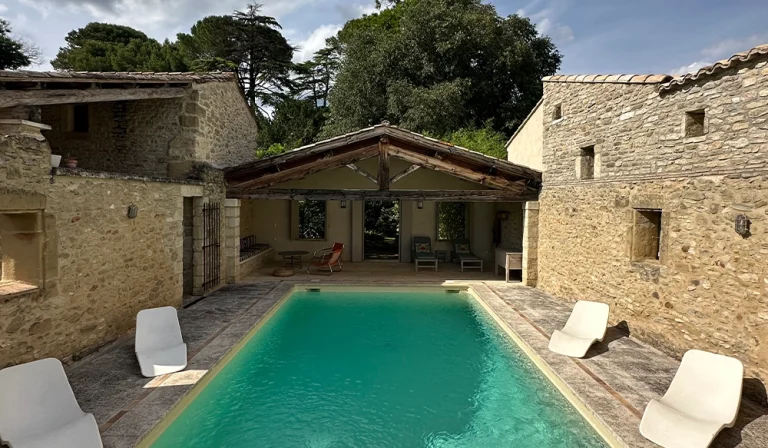
Poligano itself is worth exploring with its flat-roofed, box-shaped buildings perched on the cliff edge above turquoise water. Try the town’s famous caffè speciale – coffee spiked with sugar, cream, lemon zest and amaretto. For fine-dining in a jaw-dropping location, book a table at Grotta Palazzese, set in a cave above the crashing waves. If you’re keen on basing yourself in Polignano a Mare, we offer a stunning 17th-century farmhouse, Masseria Le Torri, surrounded by centuries-old olive and oak trees and fruit orchards – a perfect hideaway epitomising authentic Italian country living.
The quaint nearby town of Monopoli has some of the best beaches in Puglia. You can choose from rocky concrete or sandy beaches, all with their own unique charm. The Cala Porta Vecchia is the old town’s closest ‘beach’ where you lay your towel on a stretch of concrete jutting out from the city walls. It doesn’t sound appealing, but the warm, clear water and views of the old city towering above you make it more than worthwhile.
Further south, picturesque Otranto offers both city beaches within the old town and numerous fine beaches just outside, including the famous Baia dei Turchi where a path leads through fragrant pine forest to a white-sand beach lapped by pellucid waters that look more tropical island than Italian boot. On scorching days, cool down at rocky Cala dell’Acquaviva, where salt and spring waters mingle to invigorating effect.
Heading further down the coast, we found great swimming spots near the tip of Puglia’s heal. Despite the rocky shoreline at Castro Marina, walkways lead down to the water where you’ll find nooks to plant your umbrella or rent one along with a sun lounger. It’s a popular spot for swimmers and pedal boaters who, seen from above, look like they’re suspended above the crystal-clear water.
Further south, the village of Gagliano del Capo has a stunning cove, Ciolo, reached down a steep flight of steps at the mouth of a scenic canyon, the Canale del Ciolo. The tiny beach lies beneath a 40-metre-high bridge and the swimming, snorkelling and hiking here are wonderful.
In contrast to the rocky coves of the Adriatic coast, the Ionian shoreline (the instep of Italy’s boot) has long sandy beaches stretching northwest to the trendy town of Gallipoli. In high summer, the hip and the beautiful descend en masse to soak up the sun on Gallipoli’s superb beaches.
Nearby Nardò has a lovely wild shoreline fringed with creamy sand reached along pathways of fragrant Mediterranean scrub. Check out the remote, pebble beach of Porto Selvaggio (set in a nature park) as well as the charming cliffside coves of Santa Caterina with its small beaches and beach clubs.
Trulli tripping
Northwest of Ostuni lies the Valle d’Itria, a bucolic realm of undulating vineyards, olive trees and trulli houses. These conical structures are unique to Puglia, and you’ll find the greatest concentration of them in the Unesco World Heritage Site of Alberobello, a surreal town that appears to have been created by gnomes.
The zona dei trulli on the town’s western side is a warren comprising 1 500 of these beehive-shaped houses. The drystone buildings are constructed using local limestone and some date from as early as the 14th century. You can wine, dine and souvenir shop in many of them, and be sure to visit Trullo Sovrano, a living museum that gives visitors at taste of trulli life in the 19th century.
There’s no better place to explore the wide, weird and wonderful variety of trulli houses than in Alberobello
Be warned, this town gets overrun with tourists, so arrive early or visit in the evening to avoid the crowds. Parking your hired car in towns such as Alberobello can be tricky, especially in high season. If you don’t mind a bit of walking, find a spot away from the centre and remember that only parking spots marked with white lines are free; blue lines are metered bays, while yellow lines denote disabled parking.
The southern circle
We set aside a full day for a clockwise drive of the ‘southern circle’, taking in the major sights of Italy’s heel. Hitting the road early from Ostuni, we followed the SS613 highway to the university town of Lecce. Boasting a stunning array of 17th and 18th-century baroque buildings, Lecce has a completeness and homogeneity that most other southern Italian cities lack. So distinctive is Lecce’s architecture that it has acquired its own name, barocco leccese (Lecce baroque), a highly decorative style rich in gargoyles, asparagus columns and cavorting gremlins.
The city’s architects and craftsmen turned the region’s soft limestone into outrageously flamboyant buildings. Grandest of all is the Basilica di Santa Croce, whose ornate facade is a riot of griffins, wolves, lions, cherubs, flowers and fruit. Telamons – columns in the shape of giant figures in Turkish dress – groan under the weight of a balustraded balcony beneath a magnificent rose window.
The city’s cathedral dominates Piazza del Duomo, itself a baroque masterpiece, that glows ethereally in evening light. Hang out in one of the piazza’s cafes and watch the Lecce world saunter by while munching on the local favourite, pasticciotto, a short-crust pastry filled with delicious crema pasticcera (Italian pastry cream).
Lecce’s architectural legacy reaches way further back than the baroque period. On Piazzetta Castromediano Sigismondo, glass floor panels offer a view down into a Renaissance oil store; while at nearby Museo Faggiano, the search for a sewage pipe led to the discovery of millennia-old subterranean relics, among them a pre-Christian Messapian tomb and a Roman granary.
Palazzo Bozzi Corso, Lecce (sleeps 18 in 9 bedrooms)
Palazzo Lecce, Lecce (sleeps 12 in 6 bedrooms)
Palazzo Maresgallo, Lecce (sleeps 26 in 13 bedrooms)
Castle Elvira in Trepuzzi, just north of Lecce (sleeps 20 in 10 bedrooms)
Driving south, Hellenic ruins reminder you that much of southern Italy was once part of Magna Graecia. Less well known is the mark left by the Byzantine-era Greeks, whose influence on the cultural heritage of Puglia is still palpable in the Grecìa Salentina (Greek Salentine), an area comprising a dozen towns south of Lecce. Here, some locals still speak Griko (a variant of neo-Greek), and you’ll spot the occasional sign written in Greek characters.
Our next stop was Otranto, where more than 800 locals were slaughtered when the Ottomans invaded in 1480. For the ghoulish traveller, the skulls of the slain can still be viewed in the city’s fine Romanesque cathedral. Don’t miss the astonishing mosaic floor – one of the largest and most intriguing in medieval Europe.
Given that Otranto lies just 72kms from the Balkan coast, it’s not surprising that the town’s history is punctuated with invasions and occupations. Exploring the charming old quarter, your eyes peel away the layers of Greek, Roman, Turkish and Napoleonic history. The town also has a lovely promenade along the water’s edge, so wear a bathing costume and take the occasional plunge to cool off between bouts of sightseeing.
We headed further south on a coastal road sandwiched between prickly-pear lined cliffs and shimmering Adriatic. The route is known locally as Litoranea Salentina (the Strada Provincial 87) and boasts spectacular scenery at every turn. You’ll pass several pretty fishing ports, the white finger of Punta Palascià lighthouse, the ruin of the Torre Minervino watchtower and the citadel of Castro with its 12th-century castle and cute coves for swimming and boating.
Further down the coast, the village of Gagliano del Capo is home to a Perfect Hideaways gem. Palazzo Daniele (sleeps 22 in 11 bedrooms), with its characterful yet aristocratic ambience and Apulian or Salento-inspired dinners, ‘is just insane’, says Perfect Hideaways’s Mandi Aliverti. Adjacent to the town is the tiny cove of Ciolo, reached down a steep staircase. It’s a stunning place for a dip. Finally, we reached Santa Maria di Leuca at Puglia’s southernmost tip, where we stopped to view the iconic lighthouse and the town’s 18th-century holiday villas.
We turned northeast along a coastline strung with endless sandy beaches until we came to Gallipoli. This town is the epitome of southern Italian seduction: azure seas, laid-back locals and a picture-perfect old town perched on a small island connected to the mainland by a causeway. It’s a delightful warren of narrow lanes and intimate squares dotted with bars and restaurants. Visit the Sant’Agata Cathedral, a glorious example of barocco leccese, and the extraordinary Frantoio Ipogeo, a subterranean 17th-century olive press. In summer, a trendy set descends on Gallipoli to enjoy its chic vibe and hedonistic nightlife.
With the sun slipping into the Ionian Sea, we turned inland on the SS101 and headed back towards Ostuni. Our last stop was the delightful town of Nardò, dating back to 460 BC, where we wandered its twisting alleyways. This little gem has a quiet dignity, some very fine sandstone architecture and one of the most intimate squares in Puglia. Perfect Hideaways has several superb offerings in Nardò, ranging from a restored monastery to a grand palazzo:
Monastero Santa Teresa (sleeps 22 in 10 bedrooms)
Palazzo Manieri (sleeps 4 in 2 bedrooms)
Palazzo Tafuri (sleeps 34 in 17 bedrooms)
Casa Piana (sleeps 4 in 2 bedrooms)
Villa Tafuri (sleeps 8 in 4 bedrooms)
Town of the troglodytes
Although Matera lies just across the Puglia border in Basilicata, it is an easy (and highly recommended) day trip. We decided to overnight there, giving us the chance to explore this troglodytic wonderland more fully, opting to stay in a masseria just outside town (the old quarter is closed to traffic). You’ll find such masseria – old, fortified farmhouses – scattered across the Puglian countryside. Some are cheerfully rustic, others are decidedly chic, and many are known for their locavore restaurants and cooking classes.
Matera has a history of continuous occupation dating back to the 8th millennium BC and is famed for its cave-like houses cut into the cliffside, known collectively as the Sassi. This città sotterranea (underground city), together with its rupestrian churches, was recognised as a UNESCO World Heritage Site in 1993 and declared a European Capital of Culture in 2019. Matera is certainly one of the most astonishing places I’ve ever visited, my eyes never quite able to fully comprehend the warren-like intricacy of houses, caves and churches burrowed and stacked upon one another in spellbinding confusion, and all of it in a monochromatic sandy hue.
We wandered the labyrinthine alleys, our mouths agape, like trespassers in an ever-unfolding Escher drawing. We visited cave churches such as Santa Maria de Idris and San Pietro Caveoso, as well as the Casa Grotta di Vico Solitario cave house to learn about the city’s ancient history. That evening, we found ourselves on a restaurant balcony that offered sumptuous views over the città sotterranea, and ordered local pizza topped with red onions, tomatoes and provolone, accompanied by a bottle of crisp white Greco wine, and watched a red sun sink over Matera, the scene acquiring a fairy-tale aspect as night fell and the Sassi lights began to twinkle.
Contact us now or visit our Italian collection to choose a palazzo, casa, masseria or contemporary villa for your next holiday in Puglia.
Text and photographs: Justin Fox